2026 state of play
The world is falling behind its Paris Climate Agreement goals. Of the 45 indicators monitored by the World Resources Institute, not one is on track to achieve its 2030 target.[i] This could worsen as the rise of energy-intensive technologies like artificial intelligence increases demand for fossil fuels and clean energy alike.[ii]
Since 2024, the US federal government has rolled back its policy and regulatory support for the green transition (i.e., the shift from fossil fuel-based energy systems to low- or zero-carbon alternatives). With passage of the “One Big Beautiful Bill Act,” the federal government began phasing out generous subsidies for electric vehicles, solar and wind power, and other green technologies.[1] Likewise, recent regulatory changes, if upheld in court, will further undermine efforts to regulate greenhouse gas emissions.[iii]
Despite these headwinds, the growing cost-competitiveness of renewables creates grounds for optimism. To borrow a term coined by Bill Gates, “green premiums”—the price difference between green energy, technology, and products and their fossil fuel-powered equivalents—have fallen for many technologies and goods in recent years. As a result, it is less cost-prohibitive than ever before for consumers and industries to switch to green alternatives.[iv] For example, solar and wind power, even without subsidies, are now cost competitive with, if not less expensive than, gas and coal power.[v] Similarly, as the price of electric vehicles has fallen, adoption of electric vehicles has increased; as of 2024, electric vehicles accounted for 22% of all light-duty vehicle sales—up from 0.68% in 2015.[vi]
The green transition is fundamentally on firmer footing than even five years ago. In 2025, green energy generation in the United States hit a record high, accounting for more than 25% of US electricity—up from less than 10% in 2016.[vii] Despite the pullback of federal support, approximately 80% of power generation capacity planned in the United States over the next decade is renewable.[viii] The cost of solar panels, wind turbines, and grid-scale batteries has fallen sufficiently such that, according to Semafor, “building new renewable capacity remains cheaper than most alternatives, with or without government subsidies.”[ix]
This trend extends outside the United States. In China, for example, wind, solar, and battery storage deployment doubled in just three years. As China’s green energy sector has scaled, it has brought down costs, enabling many developing nations to adopt solar generation more quickly.[x] Meanwhile, in the European Union, as of 2024, most electricity now comes from clean energy sources.[xi]
The cost-competitiveness of green energy represents a paradigm shift. As the energy think tank Ember put it in their annual report, green technologies are now “too cheap to contain and too big to ignore.”[xii] Public investment in research and development, government subsidies to expand demand, and innovation in complementary technologies (e.g., lithium-ion battery improvements enabling longer-range and lower-cost electric vehicles) contributed meaningfully to this state of affairs in the United States and globally.[xiii] Thanks to this progress, green energy is now sufficiently cost-competitive that economic decision-makers across industries often opt for it without subsidy.
As a result, we can say with confidence that the green transition is happening.[2] The critical question, however, is whether the uptake of green alternatives will occur quickly enough to prevent warming in excess of 2 degrees Celsius. This question is one climate philanthropy can and must impact.
A new philanthropic playbook to accelerate the adoption of green alternatives
In light of this paradigm shift, climate philanthropists and investors should adopt a new strategic approach. Rather than attempting to fill the gap from lost subsidies and playing defense, climate philanthropy should: 1) make targeted investments and grants to overcome barriers to the adoption of green alternatives and 2) steer economic actors (e.g., manufacturers, investors, consumers) from high-carbon to low- or zero-carbon, cost-competitive technologies and products.
Philanthropy cannot afford to fill the shoes of the US government or change the minds of climate skeptics. Nor should it try. The cost competitiveness of green energy presents an unprecedented opportunity to accelerate the green transition and demands a new approach. By leveraging and catalyzing private investment, philanthropy can stretch its limited resources further and better capitalize on recent investments. With targeted investments and grants to dismantle barriers to the adoption of green alternatives and blended finance mechanisms (i.e., structures that combine philanthropic, private, and in some cases public capital to de-risk investments and attract private funding) to steer economic decision-makers toward low- or zero-carbon alternatives, philanthropy can tip the scales in favor of green alternatives and accelerate the green transition.
After all, the green transition is not only about green technologies and systems outcompeting fossil fuel-powered incumbents, but ultimately about green technologies eventually replacing those incumbents, as environmental economists Marion Dumas and Pia Andres point out in their recently published book on complexity science and economics. It is not enough for green energy generation and fossil fuel generation to grow in parallel, as has largely been the case in the past decade.[xiv] Instead, for replacement to occur, green technologies and institutions must cascade across sectors (e.g., manufacturing, housing, transportation) and geographies. As Dumas and Andres write, “In each energy service (light, heat, power), in each sector (residential, industrial, transport), and in each country, a new energy source can replace an old one only if adequate complementary technologies and institutions are developed. Each location may be held back by different missing elements…causing lags or tilting choices toward the legacy system.”[xv] Addressing these “missing elements” and barriers is therefore essential for enabling green technologies, products, and services to replace fossil fuel-powered incumbents.
Philanthropy can help address the “missing elements” that tilt decision-makers towards fossil fuel-based incumbents by (1) tackling barriers to widespread adoption of green alternatives that may or may not yet be cost competitive and (2) steering economic decision-makers toward cost-competitive, green technologies and systems. In the process, philanthropy can unlock private investment and accelerate momentum.
1) Overcome barriers to adoption of green alternatives with targeted investments and grants
Climate philanthropy can deploy targeted investments and grants to dismantle barriers to the adoption of green alternatives across economic sectors and geographies. Without philanthropic intervention, these barriers may go unaddressed within the timeframe necessary to achieve climate goals. Philanthropy can play a catalytic role by helping diagnose and remove barriers to the adoption of green alternatives that may or may not yet be cost-competitive. In doing so, climate philanthropy can clear the way for private capital and decision-makers to adopt and scale green alternatives that they otherwise might not.
A first step in identifying barriers is to assess a green alternative’s deployment stage. For the purposes of this article, we can classify the deployment of green alternatives in three stages. First, in the demonstration stage, technologies have proven technical feasibility but limited, if any, commercial deployment. Second, in the commercializing stage, technologies have some initial commercial activity (e.g., early revenues, private investment) but are not yet cost-competitive or deployed at scale. And third, in the established stage, technologies have broad market penetration, competitive costs, and mature supply chains. For established green technologies like solar and wind, lower-interest philanthropic capital may be sufficient to make solar and wind preferable in the eyes of investors. By contrast, for technologies in the demonstration stage like carbon dioxide removal, pilot projects and further research and development are likely necessary to lower the green premium.
Next, by mapping the value chain—from manufacturers, distributors, and investors to installers/implementers, regulators and policymakers, and end users—philanthropy can assess each actor’s readiness to deploy a given technology. Barriers inhibiting the development and deployment of cost-effective green alternatives may include:
- Inadequate research and development funding: For a green alternative to be deployed, it must first be functional and relatively cost-competitive. Research and development funding is vital for reaching this stage.
- Supply bottlenecks: Shortages of critical minerals, labor, and/or manufacturing capacity, for example, can raise the cost of green alternatives. Likewise, where adoption depends on changing how users work (e.g., sustainable agricultural practices), gaps in practical knowledge and skills can slow uptake.
- Insufficient financing: Financial actors must be convinced of the likelihood of a rapid transition in order to shift investments toward zero- or low-carbon technologies and away from high-carbon ones.
- Infrastructure gaps: Transmission lines, for example, have proven a major barrier to connecting solar and wind power produced in rural areas to urban grids.
- Insufficient motivation or demand: Adoption of green alternatives requires behavior change from consumers and producers. Without demand, even the most cost-competitive technologies will struggle to scale.[xvi]
- Policy or regulation: Policies and regulations may hinder promising technologies (e.g., modular nuclear reactors, offshore wind) from being deployed. While less determinative than before, supportive policy and regulatory environments remain important for accelerating the green transition. Therefore, it is still beneficial to understand what policy and regulatory barriers exist in order to assess whether and how philanthropy can help surmount them.
By identifying the primary barriers to adoption, philanthropy can uncover targeted investment and grantmaking opportunities to remove those barriers, lower costs, and spur adoption. Let’s dive into a few examples to demonstrate how identifying barriers can inform targeted philanthropic investments and grants.
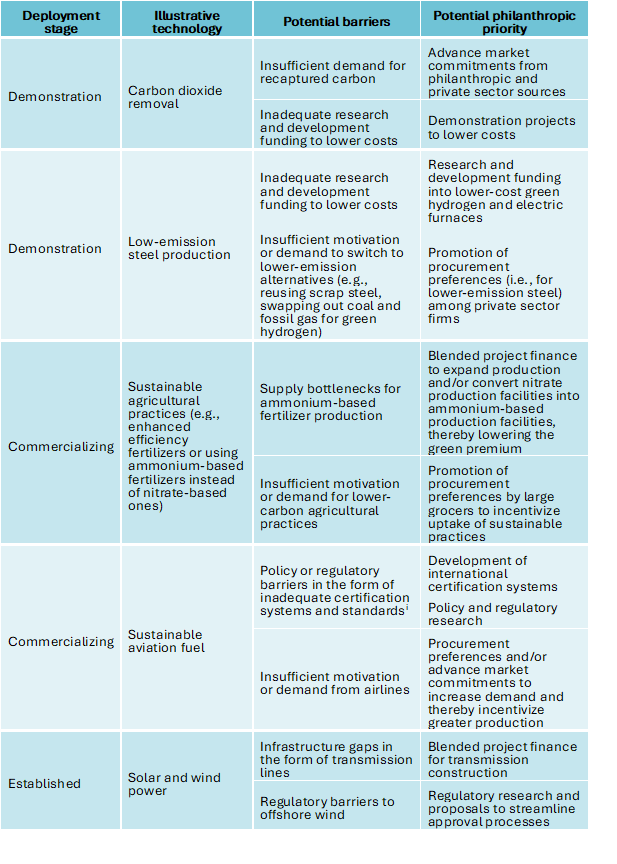
As the examples above illustrate, by identifying the primary barriers to the deployment and adoption of green alternatives, climate philanthropy and like-minded private sector actors can target funding to overcome those barriers and thereby unblock adoption of green alternatives.
2) Steer economic decision-makers toward cost-competitive green alternatives
By utilizing blended finance mechanisms, climate philanthropy can make green alternatives the more attractive economic choice for private decision-makers. Examples of blended finance mechanisms include concessional capital, risk guarantees, below-market rate loans, and green revolving funds. These and other tools have helped incentivize private and public investment in other philanthropic sectors, including affordable housing. Thanks to the growing cost-competitiveness of green alternatives (e.g., solar, wind, batteries), philanthropic dollars can stretch further than ever before, as economic decision-makers need fewer incentives to invest in green alternatives. Climate philanthropy can therefore steer economic decision-makers toward green alternatives with relatively limited funding.
By steering investment toward green alternatives, philanthropy can incentivize construction of the transmission infrastructure, storage capacity, and supply chains that make subsequent adoption of green alternatives faster and cheaper. High-carbon legacy systems benefit from decades of accumulated infrastructure and market advantages that make switching to green alternatives costly even when those alternatives are cost-competitive. Therefore, each incremental deployment of green alternatives helps reduce costs, grow technical expertise, and expand green infrastructure. Over time, this shifts the dynamic from a zero-sum contest between high-carbon incumbents and green challengers to one where the system increasingly favors the green transition. Shifting this dynamic can accelerate adoption of green alternatives across economic sectors and countries and improve our odds of achieving our climate targets.
Take the build-out of energy-intensive data centers for artificial intelligence as an example. In 2024, data centers accounted for 3.5% of electricity demand in the United States. By 2035, this figure is projected to more than double to 8.6%.[xviii] This surge in demand represents both a challenge and an opportunity. Data centers can be powered by fossil fuels (e.g., coal, oil, natural gas) or green alternatives (e.g., wind, solar, geothermal, nuclear). Currently, fossil fuels provide approximately 60% of the power consumed by data centers globally, according to the International Energy Agency.[xix] However, with the help of blended finance mechanisms (e.g., debt guarantees, first-loss capital, green revolving funds), climate philanthropy and investors can make the green capital stack more attractive to decision-makers and steer investment toward green energy and its associated infrastructure. In the process, philanthropy can leverage the billions of dollars flowing into data centers to expand green energy capacity, strengthen the electric grid, and build the transmission infrastructure, storage capacity, and supply chains that make subsequent adoption of greener alternatives faster and less expensive.
Conclusion
Climate philanthropists, investors, and nonprofits cannot afford to “wait and see.” While public investment and technological progress have made the green transition more durable in the face of political and regulatory headwinds, the green transition is far from foreordained, especially at the pace necessary to meet climate goals. Technological and implementation barriers continue to slow deployment of the technologies and approaches needed to keep warming below 2 degrees Celsius.
This challenge is also an opportunity for philanthropy. By tackling barriers via targeted investments and grants and steering economic decision-makers toward cost-competitive green alternatives, climate philanthropy and investors can accelerate adoption of green alternatives and advance climate progress in the face of expanding energy demand and backlash.
Sometimes, targeted investments and grantmaking are necessary to dismantle barriers and lower the costs of adopting green alternatives. At other times, all that investors, producers, distributors, and other economic actors need to choose green alternatives over fossil fuel-powered incumbents is a steer. Thanks to recent progress, decision-makers need less convincing than ever before, putting climate philanthropy in a strong position to accelerate the buildout of green systems with targeted investments, grants, and blended finance mechanisms.
Learn more
If you have any questions about the article’s background, content, or implications for your own work, please reach out. We’d love to help.
If you are interested in learning more about how funders can aggregate capital from philanthropic, private, and public funders toward a shared, ambitious goal, check out this article on project finance for permanence. And if you want to learn more about how community-based strategies can contribute to climate mitigation with low cost per ton of carbon reduced, read this report.
***
[1] For more on the impacts of the “One Big Beautiful Bill Act,” check out this piece by Redstone’s Jarrett Bell and Beth Leuin.
[2] Public investment in research and development, government subsidies to expand demand (e.g., for solar power), and innovation in complementary technologies (e.g., lithium-ion battery improvements enabling production of electric vehicles with longer ranges and at lower costs) contributed meaningfully to progress in the United States and globally.[2] But now that green energy has become so cost competitive, there is reason to be optimistic that progress will continue even with the loss of US federal subsidies.
[i] Sophie Boehm and Clea Schumer: “The State of Climate Action in 2025: 10 Key Findings,” World Resources Institute, October 2025.
[ii] Rachel Mural, Dipesh Pherwani, Chaitanya Gupta, and Yiqi Yu, “AI, Data Centers, and the U.S. Electric Grid: A Watershed Moment,” Harvard Kennedy School Belfer Center for Science and International Affairs, February 2026.
[iii] Cary Coglianese and Shelley Welton: “The Endangerment Finding and the Future of EPA’s Authority,” University of Pennsylvania: Kleinman Center for Energy Policy, March 2026.
[iv] Bill Gates, “The One Thing I Hope People Take Away from My Climate Book: Lowering the Green Premiums Is the Single Most Important Thing We Can Do to Avoid a Climate Disaster,” GatesNotes, February 2021.
[v] Benjamin Storrow and E&E News, “Wind and Solar Energy Are Cheaper Than Electricity from Fossil-Fuel Plants,” Scientific American, June 2025.
[vi] Sophie Boehm and Clea Schumer: “The State of Climate Action in 2025: 10 Key Findings,” World Resources Institute, October 2025.
[vii] Natasha Bracken, “US Renewables Hit Record High Despite Trump Pushback,” Semafor, March 2026.
[viii] Kyle Stock, “Renewable Energy Defies Trump’s Attacks, Reaching a New Record,” Los Angeles Times, March 2026.
[ix] Natasha Bracken, “US Renewables Hit Record High Despite Trump Pushback,” Semafor, March 2026.
[x] Muyi Yang et al., “China Energy Transition Review 2025,” Ember, September 2025.
[xi] “EU Is Progressing Towards Its 2030 Climate and Energy Goals While Tackling High Energy Prices, State of the Energy Union Report 2025 Shows,” European Commission, November 2025.
[xii] Kingsmil Bond, Daan Walter, and Sam Butler-Sloss, “The Electrotech Revolution,” Ember, September 2025.
[xiii] Marion Dumas and Pia Andres, “Decarbonizing a Complex System,” The Economy as an Evolving Complex System IV, 2026.
[xiv] Waga Jaffri, “Renewables Soar, But Fossil Fuels Continue to Rise as Global Electricity Demand Hits Record Levels,” KPMG, June 2025.
[xv] Marion Dumas and Pia Andres, “Decarbonizing a Complex System,” The Economy as an Evolving Complex System IV, 2026.
[xvi] Marion Dumas and Pia Andres, “Decarbonizing a Complex System,” The Economy as an Evolving Complex System IV, 2026.
[xvii] Bofan Wang, Zhao Jia Ting, and Ming Zhao, “Sustainable Aviation Fuels: Key Opportunities and Challenges in Lowering Carbon Emissions for Aviation Industry,” Carbon Capture Science & Technology, vol. 13, December 2024.
[xviii] “Power for AI: Easier Said Than Built,” BloombergNEF, April 2025.
[xix] “Energy and AI,” International Energy Agency, April 2025.